

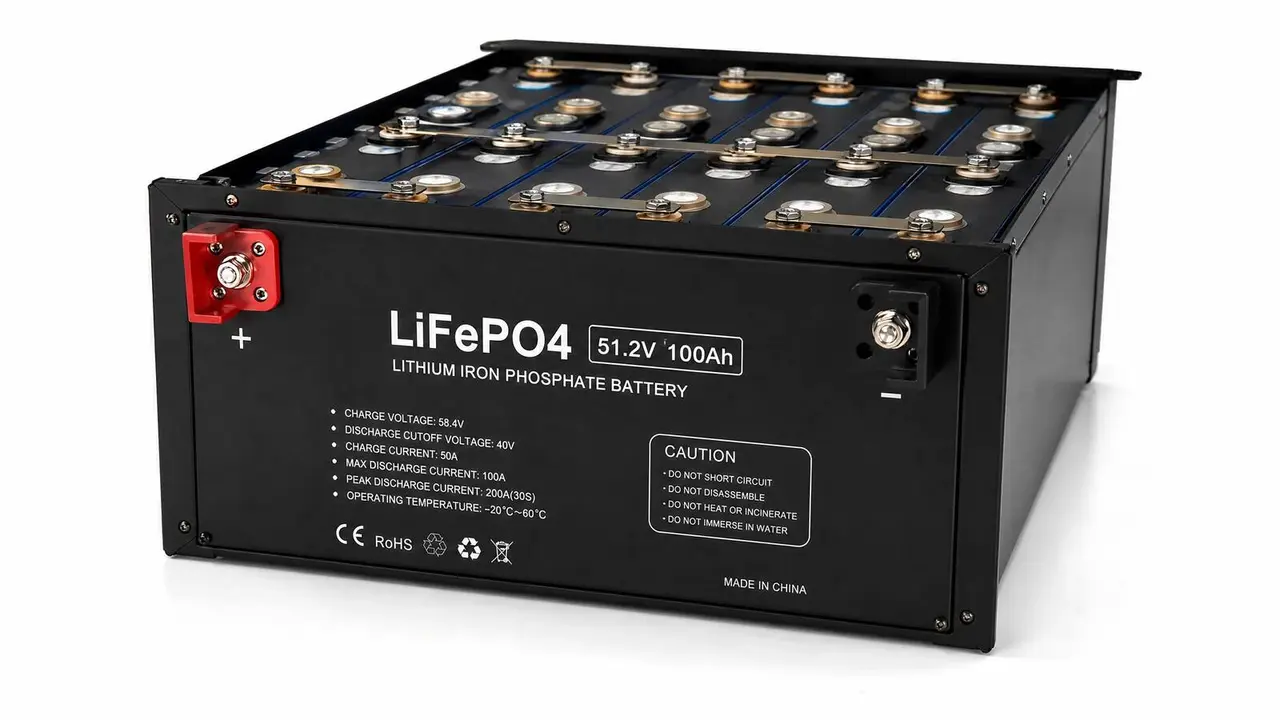
LiFePO4 (Lithium Iron Phosphate) batteries have become the chemistry of choice for a wide range of applications — from industrial equipment and telecom backup to telecom backup and industrial equipment. This guide covers everything you need to know to choose the right LFP battery for your application.
What Makes LiFePO4 Different
LiFePO4 is one of several lithium-ion chemistries, but it has a distinct set of characteristics that make it the preferred choice for many applications:
Safety: LFP chemistry is thermally stable and highly resistant to thermal runaway — the failure mode that causes lithium-ion batteries to catch fire or explode. The iron-phosphate bond is stronger than the oxide bonds used in other lithium chemistries, making LFP cells far less likely to release oxygen under abuse conditions.
Cycle Life: LFP batteries typically deliver 2,000 to 5,000 charge cycles before reaching 80% of original capacity. This is two to five times the cycle life of NMC batteries and ten times the cycle life of lead-acid batteries.
Flat Discharge Curve: LFP batteries maintain a relatively constant voltage throughout most of their discharge cycle. This means your equipment receives consistent power until the battery is nearly depleted, rather than experiencing voltage sag as the battery discharges.
No Cobalt: LFP chemistry uses iron and phosphate instead of cobalt. This eliminates the cost, supply chain risk, and ethical concerns associated with cobalt mining.
Wide Temperature Range: LFP batteries perform well across a broad temperature range, though like all lithium-ion chemistries, charging at temperatures below freezing requires special consideration.
Key Specifications to Evaluate
Voltage
LFP cells have a nominal voltage of 3.2V per cell, compared to 3.6–3.7V for NMC cells. Common LFP pack voltages:
- 12.8V (4 cells in series) — Drop-in replacement for 12V lead-acid
- 25.6V (8 cells in series) — Drop-in replacement for 24V lead-acid
- 38.4V (12 cells in series) — 36V applications
- 51.2V (16 cells in series) — 48V applications
- Determine your average current draw (amps)
- Determine how long you need to run (hours)
- Multiply: Amp-hours needed = Current (A) × Time (h)
- Add a 20% buffer to avoid deep discharging
- Continuous discharge current: Must exceed your maximum load current
- Peak discharge current: Must handle startup surges
- Charge current: Must be compatible with your charger
- Low-temperature cutoff: Prevents charging below freezing
- Communication interface: CAN, RS485, Bluetooth for monitoring
Capacity (Amp-Hours)
Capacity determines how long your battery will power your application at a given load. To calculate the capacity you need:
C-Rate
The C-rate describes how quickly a battery can be charged or discharged relative to its capacity. A 1C discharge of a 100Ah battery delivers 100 amps for one hour. A 2C discharge delivers 200 amps for 30 minutes.
For most applications, a continuous discharge rate of 1C is sufficient. High-power applications — power tools, UAVs, high-performance vehicles — may require 2C, 3C, or higher continuous discharge rates.
BMS Specifications
The Battery Management System is as important as the cells themselves. Key BMS specifications to evaluate:
Choosing the Right Cell Format
LFP batteries are available in cylindrical, prismatic, and pouch cell formats.
Cylindrical LFP cells (32700, 26650, 18650) are well-suited for applications requiring a compact, modular pack design. They are mechanically robust and have mature manufacturing processes.
Prismatic LFP cells (50Ah–320Ah) are the preferred format for large-capacity applications — stationary storage, commercial vehicles, industrial equipment and telecom backup. The rectangular form factor allows efficient packaging and simplified assembly.
Pouch LFP cells offer design flexibility and high energy density but require more complex mechanical support.
Application-Specific Recommendations
industrial equipment and telecom backup: 12.8V or 25.6V prismatic LFP packs are the standard choice. Look for IP67 or higher ingress protection rating and industrial-grade terminal hardware.
Telecom Backup: 48V LFP packs designed as drop-in replacements for VRLA lead-acid batteries. Key requirements: float charging compatibility, high-temperature tolerance, and long calendar life.
Industrial Equipment (AGVs, forklifts): 24V, 48V, or 80V LFP packs with high continuous discharge current capability and opportunity charging support.
Defense and Military: Custom LFP packs built to MIL-STD-810 requirements. Ruggedized enclosures, wide temperature range, and military connector interfaces.
Why Choose Lithium Battery Company
Lithium Battery Company manages custom LFP battery programs for OEM programs across every major application. Every pack is built to order with fresh cells, includes a matched BMS, and is tested before shipment.
Our engineering team works directly with your program to select the right cell, design the pack architecture, and specify the BMS for your application. We support programs from 10-unit prototypes to 300,000+ annual unit production.
Contact us to discuss your LFP battery requirements.